Remember the Ladies: A Fourth of July Love Letter
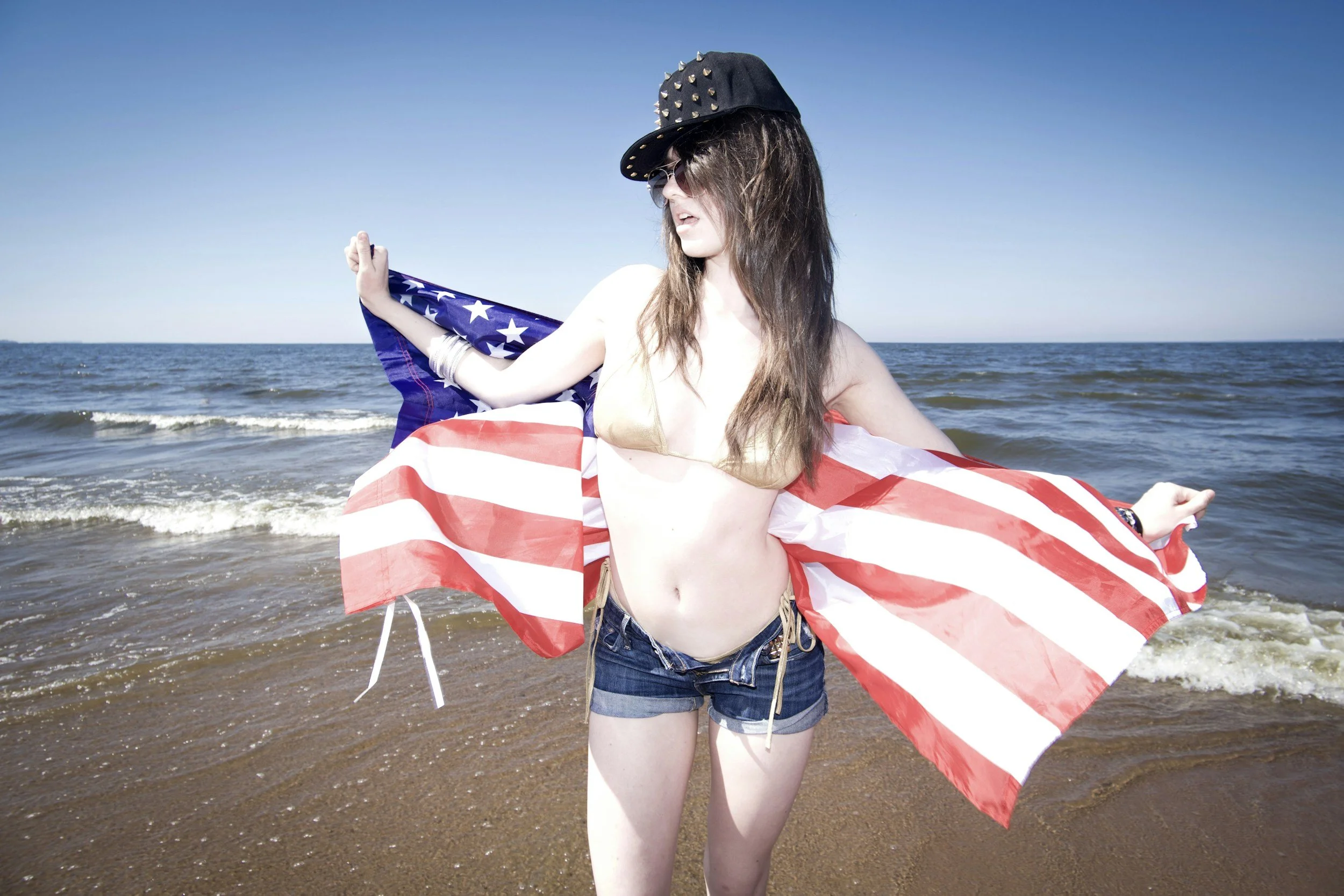
Happy 250th Birthday, America.
No, really.
I mean that.
I love this country.
I love its audacity.
I love its stubborn optimism.
I love the impossible experiment that declared ordinary people could govern themselves instead of kneeling before kings.
I even love the contradiction.
Because America has always been a nation caught somewhere between what it is and what it claims to be.
That's what makes Independence Day worth celebrating.
Not because our history is perfect.
Because our ideals were—and still are—worth arguing over.
Every Fourth of July, we hear the opening words of the Declaration of Independence.
"We hold these truths to be self-evident, that all men are created equal..."
They're among the most famous words ever written.
They're also among the most misunderstood.
The Declaration wasn't a legal document.
It granted rights to no one.
It abolished nothing.
It freed no slaves.
It enfranchised no women.
It was, first and foremost, a revolutionary manifesto—a document intended to persuade, inspire, justify rebellion, and announce to the world why thirteen colonies believed separation from Britain was morally legitimate.
Its power came from its philosophy.
Its limitations came from its history.
And history is rarely comfortable.
Consider Abigail Adams.
Months before independence was declared, she famously wrote to her husband John Adams urging him to "Remember the Ladies."
She warned him that "all men would be tyrants if they could."
John laughed.
Literally.
He dismissed the suggestion with humor.
The request wasn't merely rejected.
It was treated as amusing.
Modern Americans often assume the Founders simply forgot women.
They didn't.
The historical evidence suggests something far more revealing.
Women were largely understood not as independent political individuals but as members of households represented by fathers or husbands. That assumption was embedded in centuries of political philosophy inherited from England and Europe. Even the Constitution's references to "persons" and "people" did not translate into equal political standing for women. As historian Mary Beth Norton argues, women were effectively outside the political community envisioned by the founding generation.
That's not an attack on America.
That's history.
And history deserves honesty.
Now let me earn my annual "Feminazi" badge.
Merriam-Webster defines oppression as the unjust or cruel exercise of authority or power.
Think about that.
For thousands of years, the beginning of menstruation—menarche—has marked the transition from girlhood to womanhood across countless cultures.
How often have girls heard some version of:
"You're a woman now."
It sounds celebratory.
Sometimes it isn't.
Sometimes it became permission.
Permission for child marriage.
Permission for arranged marriages.
Permission for religious polygamy.
Permission for treating girls as reproductive resources rather than autonomous human beings.
The biological capacity to bear children became justification for limiting everything else.
History is full of societies that celebrated women as mothers while denying them equal agency as citizens.
That's a contradiction worth wrestling with.
Because if governments recognize a girl as biologically capable of reproduction, shouldn't her bodily autonomy matter just as much?
Whatever one's political position on contraception or reproductive policy, that question deserves serious philosophical consideration.
The Declaration proclaims that human beings possess certain unalienable rights simply because they are human—not because governments grant them permission.
That idea changed the world.
It also challenged future generations to ask:
Who counts?
For much of American history, the answer was incomplete.
Women.
Enslaved people.
Native Americans.
Many immigrants.
History has been, in many ways, the gradual expansion of the circle.
And that expansion hasn't happened only in politics.
Look at sports.
The first FIFA Men's World Cup was held in 1930.
The first FIFA Women's World Cup wasn't held until 1991.
Sixty-one years later.
Sixty-one years.
Think about that.
Today, millions around the world are watching the Women's game with the same passion once reserved almost exclusively for men.
Talent didn't suddenly appear in 1991.
Opportunity finally did.
That's an important distinction.
Progress is rarely about discovering human potential.
It's usually about finally deciding to recognize it.
The American story isn't one of perfection.
It's one of unfinished work.
The Declaration gave us extraordinary principles.
Future generations have spent 250 years asking whether we truly believe them.
That's not anti-American.
That's profoundly American.
Frederick Douglass asked.
Elizabeth Cady Stanton asked.
Susan B. Anthony asked.
Martin Luther King Jr. asked.
Every generation asks.
And every generation should.
Because patriotism without criticism becomes propaganda.
Criticism without gratitude becomes cynicism.
The healthiest nations are capable of both.
So this Fourth of July, celebrate.
Grill the burgers.
Watch the fireworks.
Wave the flag.
Cheer for the remarkable experiment that has endured for 250 years.
But don't confuse loving your country with pretending it has never failed to live up to its own ideals.
Real love demands honesty.
Real patriotism demands courage.
Real freedom demands that we keep asking difficult questions—even when they make us uncomfortable.
Especially then.
Happy Birthday, America.
Here's to the next 250 years of becoming a little more worthy of the words we declared to the world in 1776.
